Resources
Where to read the primary sources.
Everything below is created and shared by concerned citizens. It pulls in public and crowdsourced data to help understand the scope of surveillance in our country.
Look up your own area.
Start with your own plate, then look at what is installed around you. The maps are crowdsourced, which means they stay incomplete until somebody local fills the gaps.
-
Have I Been Flocked?
Type in your plate and see whether it appears in the Flock search logs released so far. The Agencies menu at the top breaks the same records down by department, so you can read what your local agency has been searching for.
-
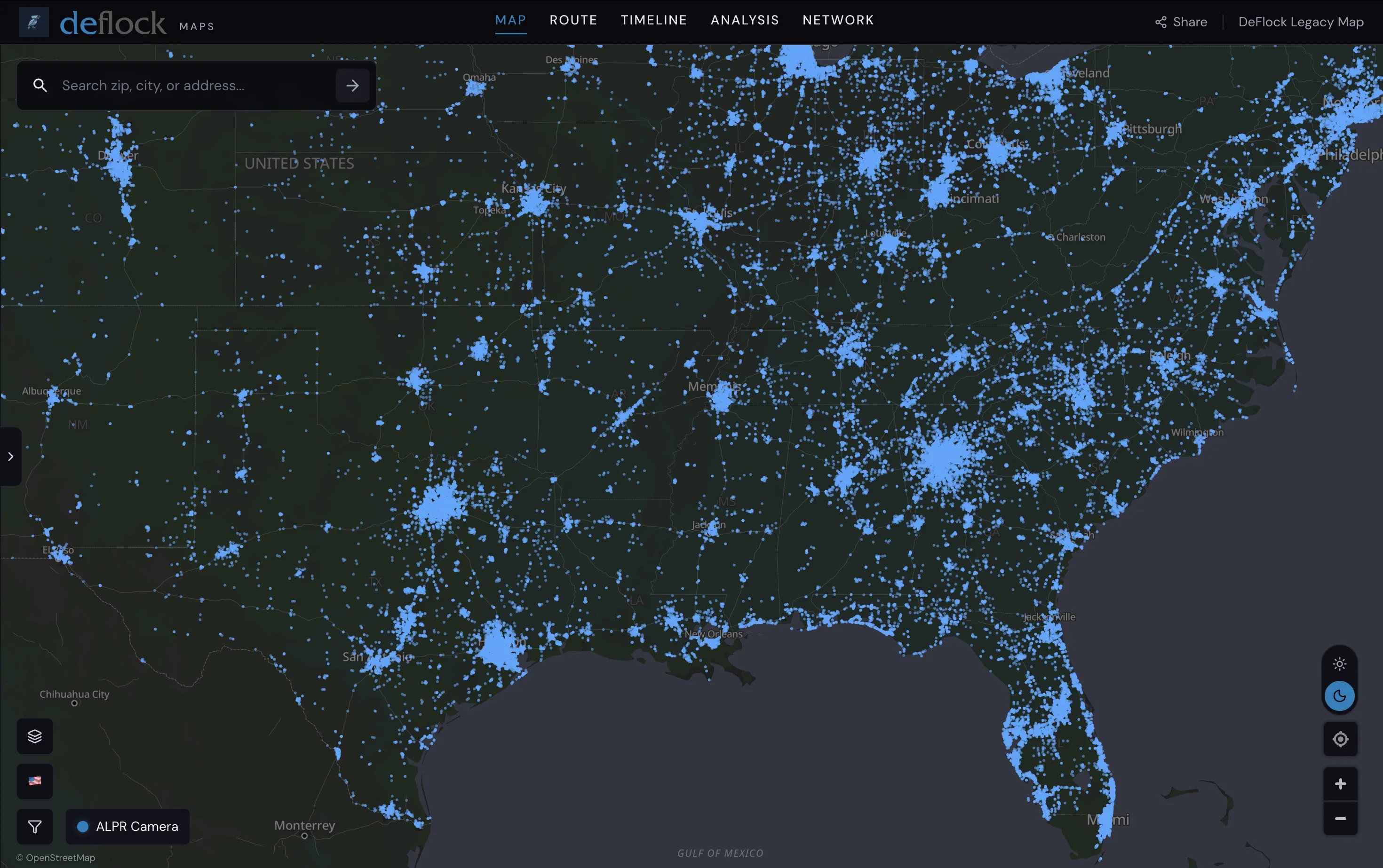
DeFlock
Open-source map of license plate reader locations, built on OpenStreetMap data. Adding a camera takes a couple of minutes.
-
Atlas of Surveillance
Documents police technology by agency, from EFF and the Reynolds School of Journalism at the University of Nevada, Reno. Useful for finding what else your department runs.
-
OpenStreetMap
The underlying map. DeFlock submissions land here, so an edit outlives any one project.
Understand the technology.
What the hardware captures, what the software does with it, and how the sharing networks are put together.
-
EFF Street-Level Surveillance
Plain-language explainers on plate readers, drones, face recognition, cell-site simulators and the rest of the municipal catalogue.
-
EFF: Automated License Plate Readers
The issue page, kept current with litigation and legislative developments.
-
ACLU: Surveillance Technologies
Reports and campaign material, including the model Community Control Over Police Surveillance ordinance.
-
EPIC
The Electronic Privacy Information Center. Litigation, FOIA work and policy analysis going back to 1994.
The legal ground.
Whether a month of location history counts as a search under the Fourth Amendment is being argued in court right now.
-
Carpenter v. United States
The 2018 Supreme Court decision holding that pulling a person's historical location records is a search that needs a warrant. It is the case our argument rests on, so read it rather than taking our summary of it.
-
The IJ Database of ALPR Abuse
The Institute for Justice has cataloged more than 200 incidents of plate reader abuse: romantic stalking, wrongful stops and detentions, use by people who are not law enforcement, and other misconduct. Documented and mapped.
-
Institute for Justice
Litigating Fourth Amendment challenges to municipal camera networks, including the case against Norfolk, Virginia.
-
Restore The Fourth
National volunteer organization focused on the Fourth Amendment, with local chapters.
-
Surveillance Technology Oversight Project
Litigation and model legislation on municipal surveillance.
-
Center for Democracy & Technology
Policy research on government data collection and the rules that should attach to it.
Reporting worth reading.
Most of what is publicly known about how these systems get misused came out of records requests filed by journalists.
-
404 Media
Sustained investigative coverage of Flock Safety, including audit logs obtained by records request.
-
EFF Deeplinks
EFF staff blog. Faster than the issue pages and usually where new findings appear first.
-
MuckRock
Nonprofit newsroom and records-request platform. Journalists, researchers and the public file requests through it, and the results stay published, so you can read what other people have already pried loose.
Read them yourself rather than taking our word for any of it.
Florida and St. Johns County.
Florida has one of the broader public records laws in the country. Use it.
-
Florida Statutes
Chapter 119 is the public records law. Chapter 286 covers open meetings.
-
Government-in-the-Sunshine Manual
The Attorney General's annual guide to what is public, who must release it and how long they may take.
-
ACLU of Florida
State affiliate. Tracks surveillance legislation in Tallahassee.
-
St. Johns County
Commission agendas, meeting video, budget documents and the records request portal.
-
St. Johns County Sheriff's Office
Agency contact details and published policies.
-
City of St. Augustine
The city runs its own police department and its own procurement, separately from the county.
-
Public records we have received
Contracts, the sheriff's plate reader policy, training material and released record sets, exactly as the agencies sent them. Read them yourself rather than taking our word for any of it.
Protect yourself in the meantime.
None of this fixes the camera on the pole. It reduces how much everything else knows about you.
-
Surveillance Self-Defense
EFF's practical guides, organized by threat model rather than by tool.
-
Privacy Guides
Maintained recommendations for browsers, messaging, email and DNS, with the reasoning attached.
Something missing?
Send it to us. We add links that publish documents, explain the technology or help somebody file a request. We do not add anything that tells people to interfere with equipment.